

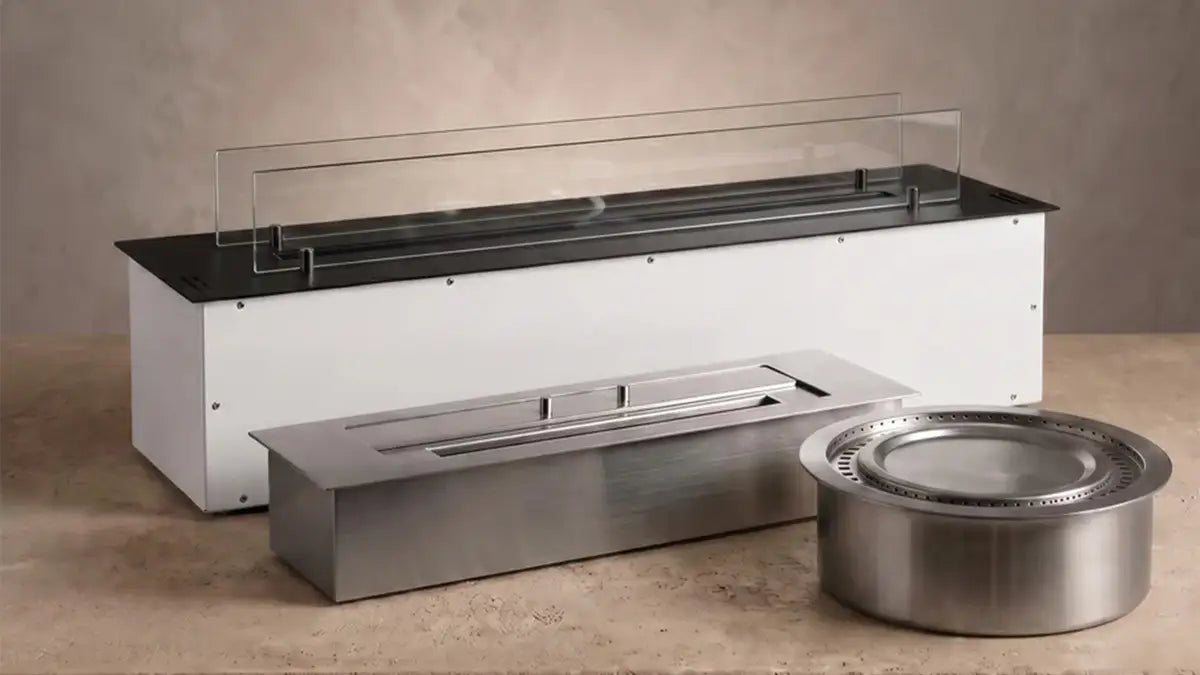
Manual or automatic bioethanol fireplace — what does that mean, and what is the difference? This refers to the burner of the bio fireplace and how it works.
Bioethanol fireplaces first appeared in 2005. The introduction of bioethanol fires made it possible to place a fireplace almost anywhere, without any venting, flue, smoke, soot, or expensive maintenance. Since then, the technology and safety standards have evolved, and today we have two types of bioethanol fires: manual and automatic bioethanol burners.
These two types each have their advantages and disadvantages. The type of burner you select depends on your requirements for the fireplace, where it will be used, and what your budget is.
Although there are only two types of bioethanol burners, products from different manufacturers can vary considerably. For this reason, the information in this guide is only indicative. For a more accurate description of each manufacturer's bio fireplace and burners, check the specific product page and read the manual linked there.
Bioethanol Fires with a Manual Bioethanol Burner
A manual bioethanol burner is a stainless steel container which you fill with bioethanol. The burner has an opening — either round or long, depending on the shape of the burner. The flame is ignited with a lighter and extinguished by smothering the fire. The manual burner is the most well-known type and is therefore found in most bioethanol fires, especially wall-mounted and freestanding models.
To increase the safety of manual bioethanol burners, almost all manufacturers use a method to prevent the bioethanol from spilling if the burner falls or tips over. The most common method is the use of ceramic fibre cotton inside the burner, which absorbs the bioethanol fuel and makes it impossible to spill if tipped over accidentally. Some burners, for example from Nordlys Denmark, use a ceramic stone instead of ceramic fibre cotton, but the principle is exactly the same. You can read more about ceramic fibre cotton in our guide: bioethanol-fireplace.co.uk/ceramic-fibre-cotton-what-is-it.

Benefits of a Manual Burner
- No power or cables required: Manual bioethanol burners can be installed and placed freely, as they do not require any power connection, chimney, vent, or flue. The only factor to consider is the size of the burner. You should still be aware of general fire hazards and safety distances.
- More affordable: Bio ethanol fires have existed for some years, with manufacturers continuously optimising production costs. Manual burners require no digital technology, which means the prices of manual bio fireplaces are considerably lower than their automatic counterparts.
Disadvantages of a Manual Burner
- Operated manually: The most obvious disadvantage of the manual bioethanol fireplace is the manual control. You have to get close to the flame to adjust or switch the burner on and off. A manual bioethanol fire should therefore not be operated by children.
- Fewer safeguards: Whilst manual burners are perfectly safe when used correctly, automatic bioethanol fires feature additional safety sensors that manual ones do not. These sensors are simply not available on a manual burner.
How to use a manual bioethanol burner:
Bioethanol Fireplace with an Automatic Bioethanol Burner
Automatic bioethanol burners require bioethanol fuel to function, just like manual burners — but this is where the similarities end.
Bioethanol fires with automatic burners are much more technically advanced. Depending on the model and manufacturer, you can control them with a remote control, via a control panel, an app, a home automation system, or Wi-Fi.
With automatic burners, the bioethanol is filled into an external fuel tank, from which it is pumped into the burner for combustion when switched on. With manual burners, you simply pour the bioethanol fuel directly into the burner opening.
Automatic burners are often found in built-in bioethanol fires and are popular for new builds, larger renovations, and interior design projects.

Benefits of an Automatic Burner
- Easy to control the flame: Automatic burners are simple to ignite and extinguish — just press a button on the remote control, the control panel, or via an app. Some models also allow adjustment of the flame size and control over the amount of radiated heat.
- Safety sensors: Automatic burners come with a range of built-in safety sensors not available on manual burners. These may include sensors that monitor CO2 levels, movement, and overheating — automatically switching the fireplace off if any danger is detected.
- Better fuel economy: Automatic burners often have better bioethanol fuel economy, as fuel is only pumped into the burner when needed. This means no fuel is wasted when switching the fireplace on and off, and unburnt bioethanol will not evaporate if left in the tank.
Disadvantages of an Automatic Burner
- Higher cost: One of the biggest disadvantages of an automatic bioethanol burner is the price. Automatic burners cost considerably more than manual ones, as the technology is still relatively new and more advanced to produce.
- Requires power: All electronic components in the burner require a power connection close to the installation point, which makes placement less flexible.
How to use an automatic bioethanol burner:


